“Hopefully... I show people mistakes I made and then they don’t have to make that same mistake. And by me being real and telling you exactly what I did and not glorifying it, or, making it look better... Then they’ll see it for exactly what it was; an experience.”
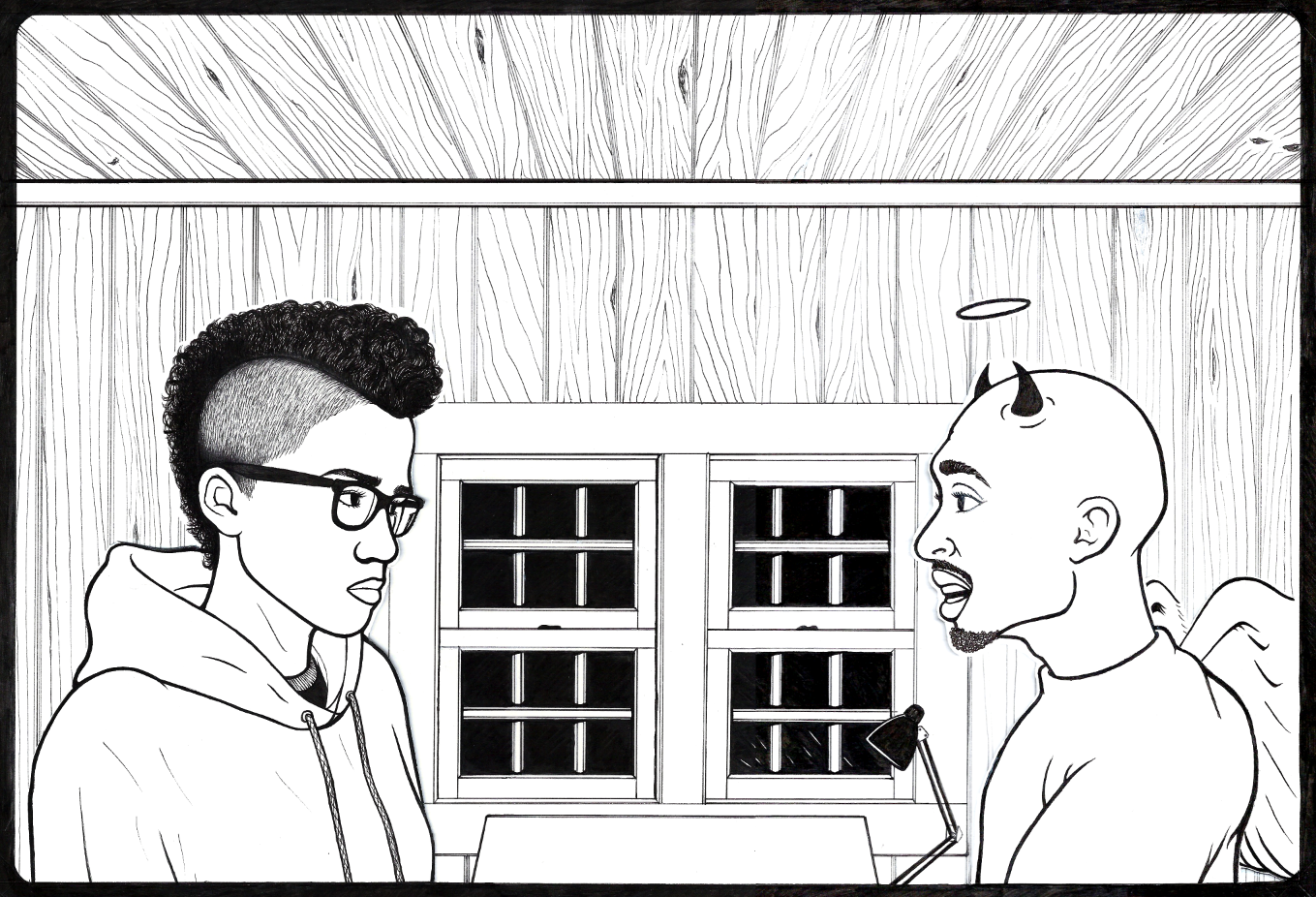
During a deposition for his court case concerning lyrics about what they then called “crooked cops”, Tupac's attorney objected to the prosecution, citing irrelevance. The prosecution said, "You're trying to make him out to be a choir boy..." Tupac responded with a genuine smile, "You're trying to make me out to be a devil." (June 1995)
Years before I began work on this book, I studied some of Chaucer’s works in Middle English at Brown University, cross-registering classes my sophomore year at RISD. We read his Dream Visions, and I can't help but think that's where I got some inspiration. The duality of Tupac's character design reflects both the image he projected to those who adored him and the image projected onto him by the media and law enforcement.
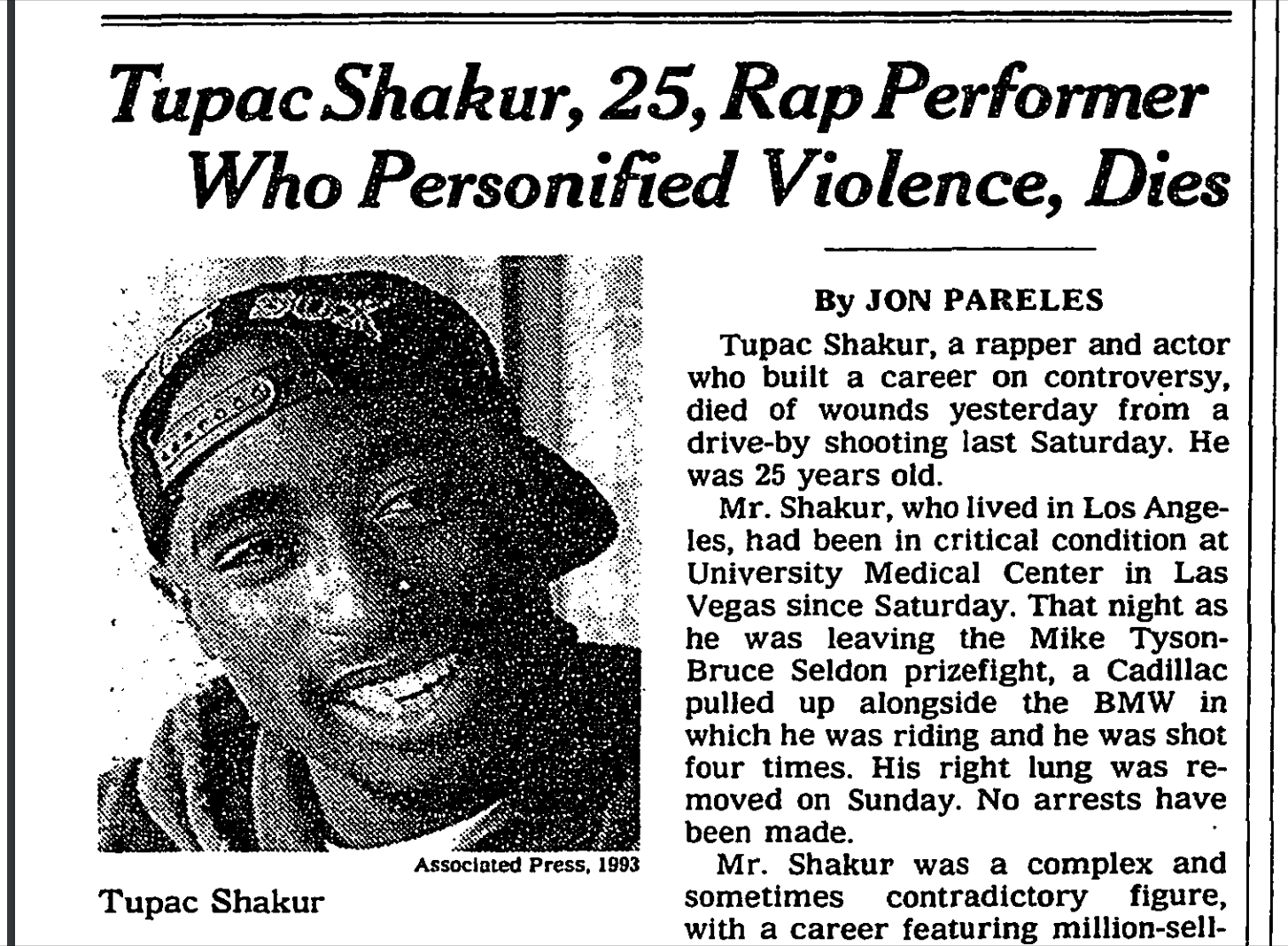
The New York Times
Since Tupac found his way into my unpublished story in the Fall of 2013, he has shown up on Broadway through Holler If Ya Hear Me (2014) and in theaters everywhere with "All Eyez On Me" (2017). I have not seen either production nor have I heard Kendrick Lamar's 2015 use of audio clips from Tupac’s interviews. I decided early on that I wanted to stay with my experience until I was finished, and that it would be affected in some inauthentic way if I saw what other people were doing. Tupac’s message was remembered in Angie Thomas’ young adult novel The Hate U Give; a film adaptation was released in 2018. I read the book and saw the film.
"They took your idea," a lot of Midwestern folk told me on these occasions. I assured them there is no official limit for how often an historical figure can show up after their death. Artists and writers have shown how new work can effectively carry on Tupac's legacy, introducing future generations to a leader who was for many the one who opened the door to a wealth of knowledge, a history left out of American textbooks (and he'll tell you why they left it out).
When I arrived at the last poem in Tupac's book of poetry, The Rose That Grew from Concrete, it made me so deeply sad to know how young he was when he wrote this. He was right that he would die young, but the cause was for nothing, his murder unsolved. His book of poems contains photocopies of his original handwritten pieces on the verso with typewritten versions for clarity on the recto, meaning I could trace his handwriting and use magical realism to give one of them back to him, so he could physically produce it for me in the graphic memoir.
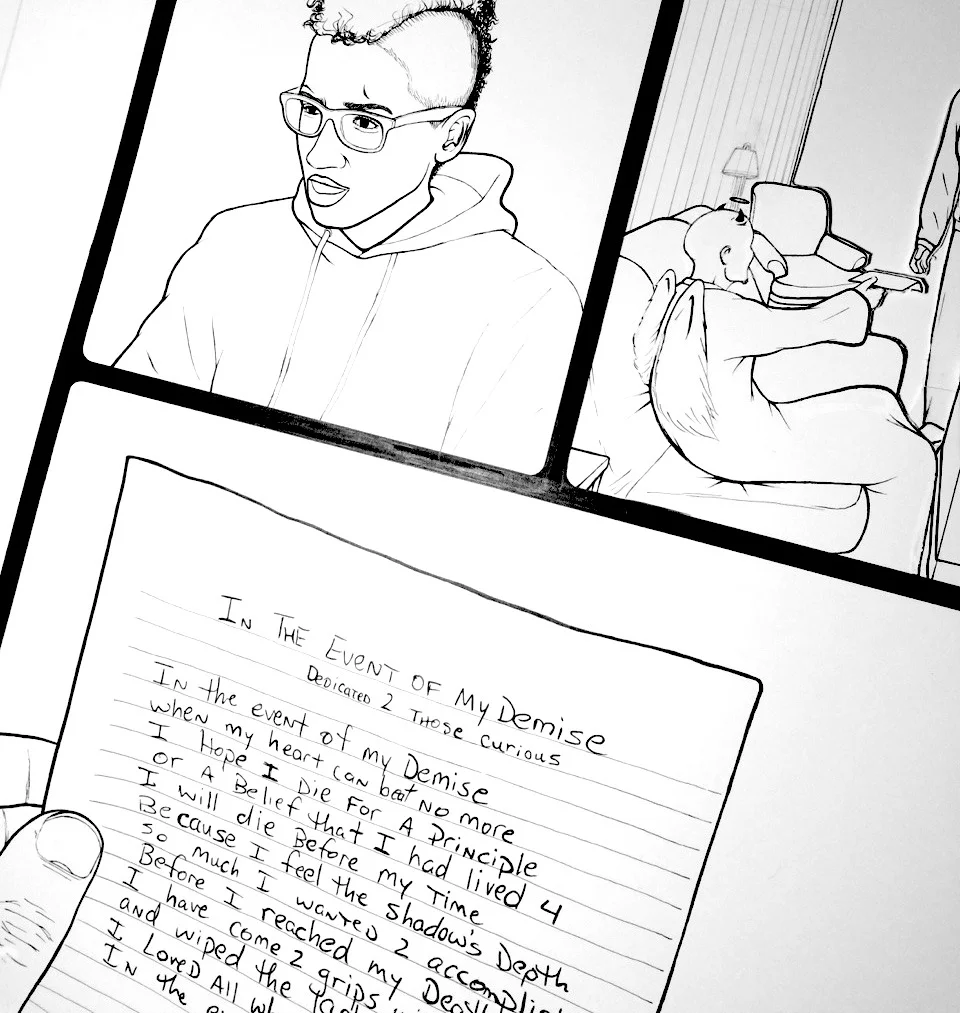
Drawing Tupac into my story was essentially magical realism: this is the creative license I have taken, rather than drawing pictures of myself watching his interviews on my laptop.
Everything Tupac says to me has been transcribed from his interviews and other documentary footage. Listening to the people interviewing Tupac, as in the off-camera audio from his 1988 "Thug Angel" interview, I noticed the questions asked by white interviewers were most like my own, including their unapologetically condescending amusement when they finally get past their racist skepticism and can see that he is intelligent, which entertains them.
The supernatural aid he provides comes in the form of books, appearing on shelves out of thin air at his will. Several of these are books I found on Tupac’s reading list after I overcame my aversion to Black literature and critical race theory—books I believed exacerbated the problem, without even knowing what they said, or understanding “the problem”.
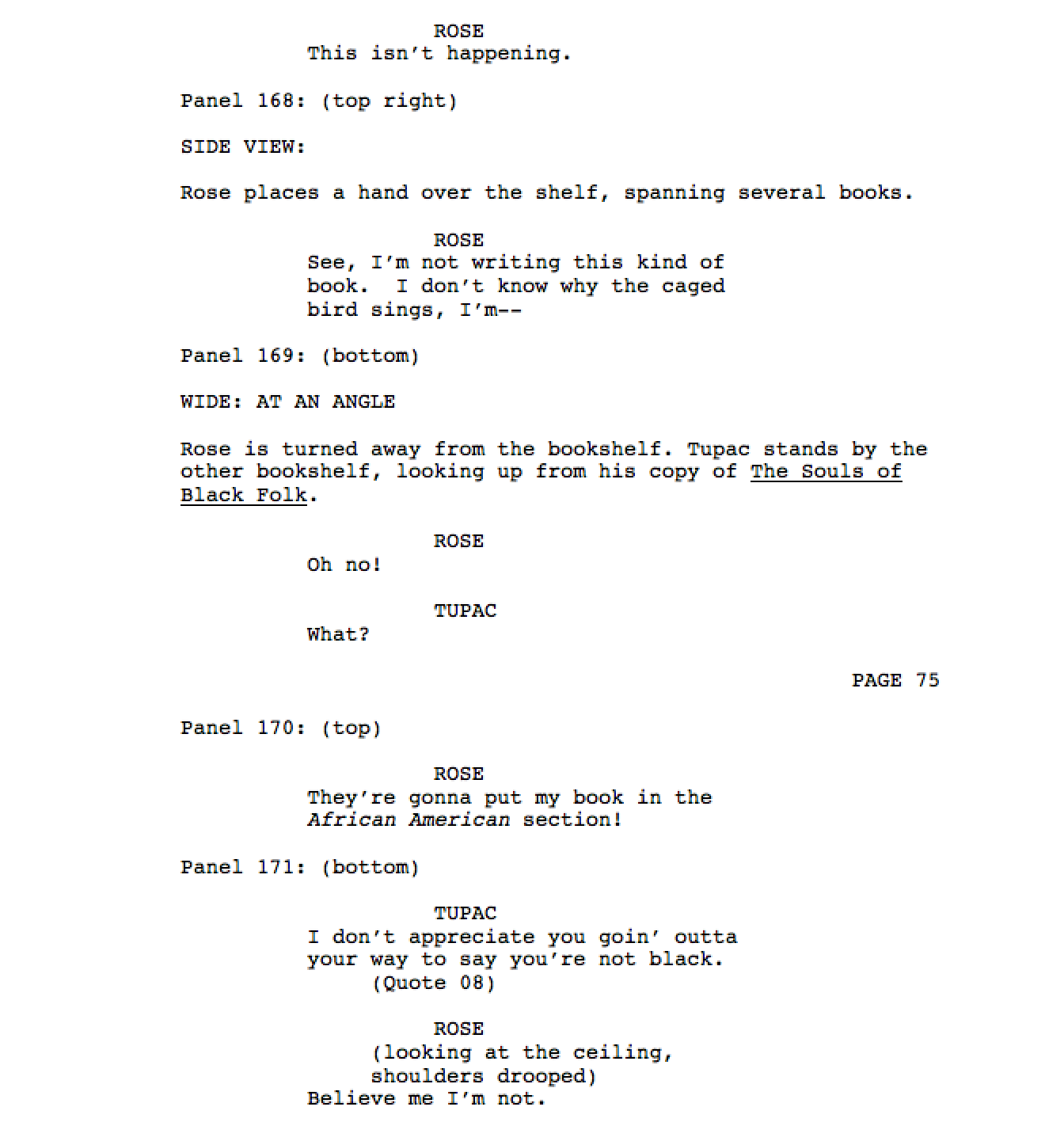
If I knew anything about the African American section of the bookstore, it was that people only go there if they already care, and many outright avoid it. I spent a lot of time and energy criticizing the methods of Black activists without reading their words; ultimately I would recognize this pattern, finding the common ‘fear itself’ was that I would be dismissable on sight, and to believe I could distinguish myself from that kind of person by denying them myself. It wasn't profound and new, this insight. But it also wasn't the root, the belief that there was something people did to be put in the African American section, which is to say be seen as Black; in my experience, this came after the work I did to unlearn the violence I was trained to project onto blackness. And so that work can be done, and it must, but I also had to understand that the perception of me as a Black person in America is a matter of fact, not of mindset or behavior.
In the above panel, I have us standing on the dock at the cabin and my character is shining a flashlight on him. The decision to break the fourth was his own (MTV Christmas interview, 1992). In the interview, he prefaced this moment by explicitly stating that he was referencing Uncle Sam, consciously using his platform to recruit anyone who saw him to join his cause by seriously asking themselves this question.